
Portugal D7 Visa Program Opportunities
Portugal D7 Visa Program
If you want to move to Portugal from the USA and other countries, the D7 Visa in Portugal may be your way in. For many years, Portugal has attracted people from all over the world to move to its sunny shores, especially for retirement. If this is the case for you, the Portugal D7 Visa is perfect. Also known as the passive income visa, it grants non-EU, EEA, and Swiss citizens who earn a regular passive income residency in Portugal.
This visa is ideal for retirees, freelancers, entrepreneurs, or individuals who generate passive income. Applicants can choose to be employed by a local company or do business while residing in Portugal if this is something they wish to do.
General D7 Visa Requirements In Portugal
It’s important that you meet all of the following D7 visa requirements to be approved:
- NIF (A Portuguese Tax Number): You may obtain your NIF remotely through a power of attorney.
- Portuguese Bank Account: As a single applicant, you must have at least €11,040 deposited in your bank account. If you are married and bringing your spouse, you will need to have at least €16,560 in your bank account.
- Proof of Passive Income and Financial Self Sufficiency: To prove that you can financially support yourself and your family, you will have to show both proof of your passive income and savings (through bank statements and savings accounts).
- Proof of Accommodation: You can buy a property or rent an apartment long term (for at least 12 months). The rental agreement must be registered with the tax authority under the main visa applicants name, meaning that rooms or sublets are not valid options.
- Health Insurance: Your health insurance should cover you EU wide and be paid for 12
months in advance. Each applicant in your party must have at least €30,000 worth of
medical insurance. - Clean Criminal Record: Certificate of your criminal record from your country of
origin.
What Is the D7 Visa in Portugal?
In response to the increasing interest of foreigners to live in Portugal, the Portuguese government introduced the D7 visa, also referred to as the passive income or retirement visa, in 2007.
Meant to attract high-earning foreigners, the D7 Visa allows applicants to obtain temporary residency, leading to permanent residency and, ultimately, Portuguese citizenship.
Anyone who meets the passive income requirements may apply for the D7 Visa. Upon obtaining the visa, it’ll be valid for 2 years, after which you can renew it and get an additional 3 years. Once 5 years have passed, you may apply for Portuguese citizenship.
Residents’ Rights
Once you’re a D7 visa holder and a resident of Portugal, you’re entitled to the following:
- The opportunity to work as an independent professional
- Portuguese healthcare services
- Local education services and schools
- Vocational and professional training, as well as retraining
- Legal protection and access to Portuguese law
Benefits of the Portuguese Retirement Visa
If your Portugal D7 visa application is successful, you’ll get to enjoy these benefits:
- Live, study, and work in Portugal
- Bring your dependent children and parents to live with you in Portugal
- Visa-free travel within the Schengen Area
- Start and run a business in Portugal
- The option to apply for NHR (Non-Habitual Resident) status, which provides you with a number of benefits when paying taxes in Portugal.
- The option to apply for permanent residency or Portuguese citizenship after 5 years
- If you’re a resident for 1 year, your newborns may become citizens of Portugal

Eligible Dependents (Family Reunification)
As part of the family reunification statute, you’re allowed to bring your family members with you to live in Portugal on a D7 visa. Here’s who you can include in your application:
- A spouse/partner
- Children under 18
- Children who are older than 18, not married, and study at a university in Portugal
- Your dependent parents or the parents of your spouse
Siblings who aren’t yet 18 years old and legally dependent on you
What Are the Passive Income Requirements for Obtaining a D7 Portugal Visa?
All applicants need to meet certain minimum income requirements. Here‟s how much you’re expected to earn:
- Single Applicant: You must earn more than €920 per month, or €11,040 per year, in passive income.
- Married Couples: If you’re applying with your partner (considered the second adult), they, and any additional adult, will need to earn at least €5,520 per year (or €460/month). This equals 50% of the minimum monthly salary. In sum, you and your partner should have at least €16,560 in total per year.
- Dependent Children: Children under the age of 18 as well as dependent adult children should have at least €3,312 per year, which equals €276 per month or 30% of the minimum monthly salary.
- Elderly Parents: If you want to bring your parents or the parents of your spouse with you, you’ll have to move first and get settled before applying for a D7 for them. They will be considered financially dependent on you, meaning you will have to fully support them and let them live with you.
Passive Income Defined
The key to getting your D7 visa application approved is proving that you are financially stable, meaning you earn regular passive income that can fully support you, even without a monthly salary.
Passive income may be earned from:
- Dividends, as long as you’re not an employee of the company
- Your pension
- Intellectual property
- Transferable equity
- Royalties
- Real estate
- Interest from your savings
- Financial investments with long-term, fixed-rate returns
- Dividends, as long as you’re not an employee of the company.
D7 Application Process
To apply for the D7 Visa in Portugal, you’ll have to complete and submit several documents. Here are the steps:
- Obtain your Portuguese tax number by allowing a trusted third party to financially represent you in Portugal.
- Once you have your fiscal number, open a Portuguese bank account.
- Find a place to live in Portugal – you can opt to long-term rent or buy a property
- Go to an interview with the Portuguese Consulate in your country of residence.
- Arrange a meeting with AIMA, which is the Portuguese Agency for Integration, Migration and Asylum

How much does the D7 Visa in Portugal cost?
A majority of your expenses when moving to Portugal will come from accommodation, flight tickets, relocation costs, health insurance, etc. In comparison, obtaining the D7, – including the legal fees – is quite cheap.
The Best Cities in Portugal for D7 Visa Holders:
In Portugal, D7 Visa holders have the liberty to choose their ideal location to settle down. However, with so many incredible cities to consider, be warned that the decision isn’t easy. That said, let’s explore the most popular cities in depth:
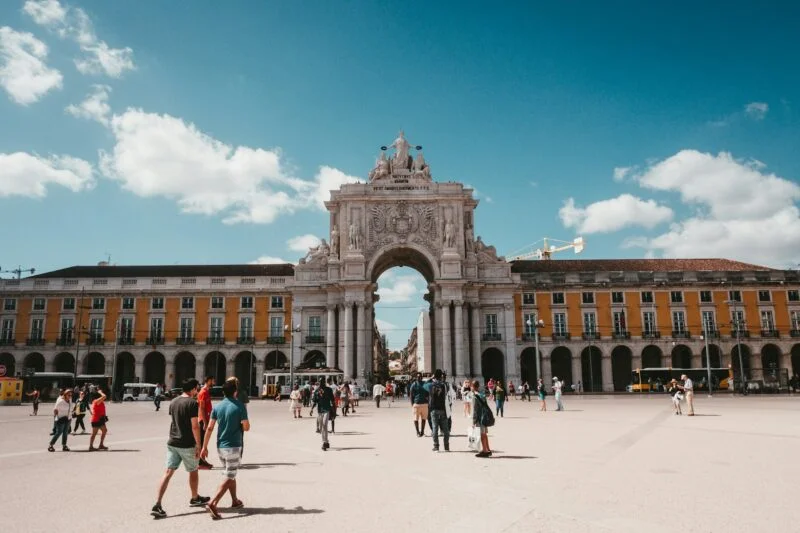
1) Lisbon: The Heartbeat of Portugal
Nestled on seven hills overlooking the River Tagus, Lisbon is a blend of tradition and modernity. The city’s old-world charm radiates from the historic neighborhoods of Alfama and Mouraria, where the trams wind through the streets, and Fado music serenades from the alleys. Yet, amidst this vintage backdrop, Lisbon surprises with its chic galleries, modern restaurants, and a nightlife that pulsates with contemporary energy. Here, gastronomy is another high point, with everything from the traditional “pastéis de nata” to innovative fusion cuisines. Moreover, the proximity to the coastal stretches of Cascais and Estoril ensures beach lovers are never too far from the sun and surf.
2) Faro: The Gateway to the Algarve
Perched on the southern edge of Portugal, Faro often remains understated compared to its neighbors in the Algarve region. Yet, this city has its own story to tell. The charm is evident in the historic old town encircled by Roman walls, where pedestrian paths unravel into scenic plazas and cafes. But Faro’s allure extends beyond its urban center, with the Ria Formosa lagoon offering a nature lover’s paradise. This protected natural park is a haven for diverse bird species and provides breathtaking settings for boat tours. Furthermore, seafood enthusiasts find solace in Faro, where the day’s catch translates to delectable dishes in local restaurants. The relative tranquility compared to other tourist hotspots like Vilamoura and Albufeira makes Faro an ideal setting for a serene retirement.
3) Porto: The Northern Gem
Residing by the banks of the Douro River, Porto’s reputation is often intertwined with its famous port wine. But delve deeper, and the city unfurls layers of culture and history. The medieval landmarks intersperse with bohemian streets, and every corner seems to have a tale from the past. Livraria Lello, considered one of the world’s most beautiful bookstores, and the intricately adorned São Bento railway station are testaments to Porto’s architectural marvels. The riverside dotted with wine cellars, beckons for a tasting session of the historical beverage. And when hunger strikes, Porto presents the Francesinha, a hearty delicacy that encapsulates the city’s culinary spirit.
4) Cascais: Coastal Elegance
Once the summer retreat of the Portuguese monarchy, Cascais has gracefully evolved into a sophisticated coastal town without losing its historic essence. Lined with beaches like Praia da Rainha and Praia da Ribeira, it provides ample opportunities for both sunbathing and water sports. The old town also resonates with a vibrant atmosphere, particularly in the evenings when local restaurants and bars come alive. Keep going, and the Cascais marina, filled with luxury yachts, adds a modern touch and serves as a launch point for oceanic adventures. With its blend of beachfront relaxation and urban amenities, Cascais promises a retirement of unparalleled grace and enjoyment.
5) Monchique: The Mountainous Escape
Situated in the highlands of the Algarve, Monchique offers a contrast to the region’s beach-centric image. The town, enveloped by eucalyptus and cork trees, is known for its therapeutic thermal springs, making it a wellness retreat. Meandering through Monchique, one encounters artisan shops selling products ranging from honey to handcrafted linen. Foia, the highest point in the Algarve, is just a short drive away, promising unparalleled views of the surrounding landscape. With its combination of natural beauty and tranquility, Monchique presents a refreshing alternative for retirees desiring a mountainous sanctuary.
6) Nazaré: The Surfer’s Haven
Known globally for its gargantuan waves, Nazaré is a surfer’s pilgrimage site. Yet, beyond the adrenaline of its shores, the town embodies traditional Portuguese coastal life. The Our Lady of Nazaré Sanctuary stands as a testament to the town’s deep-rooted faith, while the lighthouse offers insights into the town’s maritime heritage. Additionally, local eateries serve sumptuous seafood, caught fresh and cooked to perfection. While the winters witness the roaring waves and thrill-seekers, the summer months transform Nazaré into a serene beach town, ideal for those retirees looking for a blend of excitement and tradition.
About
A stunning blend of history, scenic coastlines, vibrant culture, and delicious cuisine in Southern Europe.
Citizenship
Discover the pathway to Portuguese citizenship requirements, benefits, and steps for obtaining EU citizenship.
Real Estate
Your Gateway to Real Estate and Investment Opportunities
Frequently Asked Questions (FAQ)
How Long Is the D7 Visa Valid For?
After your application is approved, the passive income visa will be valid for 4 months. You’ll then need to apply for your temporary residency permit at some point during this time. Afterward, your temporary residence permit is valid for a period of 2 years, with the possibility of renewal.
When Should I Start My Visa Application?
You may apply for a passive income visa as early as 3 months prior to leaving for Portugal. If you’re American, you’ll also be required to undergo an FBI background check, which only has a validity of 6 months. We recommend that you apply as soon as you can so you have sufficient time to get your documents in order and conduct all steps of the visa application.
How Long Does the Entire Application Process Take?
Since the passive income visa application requires two parts, it can be a lengthy process before you obtain residency. After applying in your country, you can expect a processing time of about 60 days. This may take longer if you need to provide additional documents or make corrections to your application. Once your application is approved and you fly to Portugal, you’ll be required to obtain the temporary D7 residency visa by making an appointment at AIMA. Getting an appointment may take up to 120 days, depending on where the office is located.
Can I Apply For the D7 Visa While I’m In Portugal?
You’re not allowed to submit an application for the D7 while you are in Portugal – you’ll have to apply for it from your home country and may only travel to Portugal after it is approved. Once you are in Portugal, you can apply for a temporary D7 residency permit.